

Here, we share key segments of those valuable investment and development trends. This is a case for international rights holders to take the leap into Tanzania, the Swahili-speaking market and seize the opportunities presented by its digital transformation and the boundless enthusiasm of a sports-loving nation.
A brief overview of Tanzania
A Brief Overview of Tanzania
- Population: 67 million (a similar population to the UK, but spread across a landmass 3.8 times larger).
- GDP Growth Rate: 5.7% annual 2024
- Independence: Achieved in 1961
- Top 3 Largest Cities: Dar es Salaam, Mwanza, and Arusha.
- Notable Local Teams: Yanga SC and Simba FC
- Mobile Penetration: 99%
- 4G Coverage: 83%
Tanzania’s economy demonstrated steady growth, expanding by 5.1% in 2023, up from 4.7% in 2022. On July 1, 2020, the World Bank announced that the Tanzanian economy had been upgraded to a higher income status.

Government investment and development
President Samia Suluhu Hassan’s three-year tenure has witnessed significant progress in culture, arts, and sports, all aimed at fostering national unity and identity in Tanzania.
Her leadership has bolstered sports participation at all levels, with Tanzanian athletes achieving notable successes in events such as the CAF Champions League, All African Games, and African Cup of Nations (AFCON).
A key milestone of her presidency is the revitalisation of sports infrastructure. Tanzania, alongside Kenya and Uganda, will co-host the 2027 AFCON from June 19 to July 18. Recently, a $112 million agreement was signed to construct the Dr. Samia Suluhu Hassan Stadium in Arusha.
President Samia also honoured the national football team, Taifa Stars, with a TZS 700 million reward to acknowledge their efforts, while the government contributed $300,000 to sponsor CECAFA tournaments, including the Senior Women’s Challenge Cup and the Men’s Senior Challenge Cup.
The Tanzania Football Federation (TFF) secured a 3.2 billion TZS (US$1,267,326.73) sponsorship deal with CRDB Bank for the Federation Cup, replacing Azam Media Limited.

Beyond sports, Tanzania’s improved business climate has attracted $5.68 billion in investments through the Tanzania Investment Centre (TIC), in 2024, underscoring the government’s commitment to trade and economic development.
Digitisation coverage
Key Players in telco and demographic insights
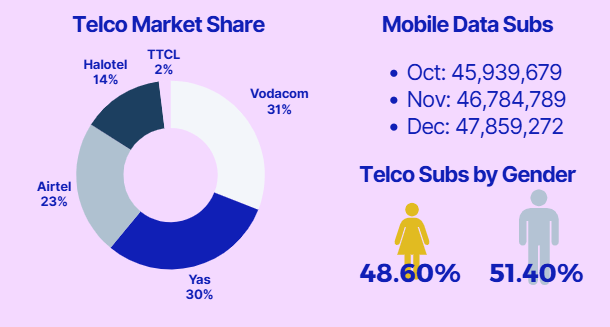
Market Leader: Vodacom Tanzania PLC
Vodacom is Tanzania’s leading mobile communication service provider, offering the fastest data network in the country and serving over 15.5 million subscribers.
Bandwidth Usage by Video Services
Video services dominate Tanzania’s bandwidth consumption, with the top platforms contributing significantly to usage (measured in GBs):
- Facebook: 48.99 million GBs
- YouTube: 35.96 million GBs
- WhatsApp: 32.2 million GBs
- TikTok: 25.9 million GBs
- Instagram (IG): 12.5 million GBs
Tanzania’s transition to digital broadcasting
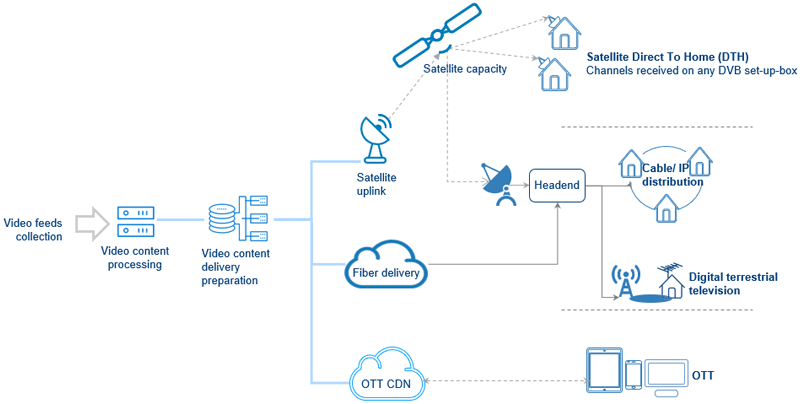
Tanzania was the first country in Eastern and Southern Africa to successfully migrate from analogue to digital terrestrial television (DTT) broadcasting in December, marking a significant milestone in media evolution.
Overview of pay-tV subscriptions in Tanzania
Active decoders by pay-TV providers
The table below highlights the number of active decoders (set-top boxes subscribed to a paid TV package at least once within a three-month period) across providers:
| Provider | DTT | DTH | Total Active Decoders |
| Azam Media Limited | 294,775 | 1,045,360 | 1,340,135 |
| Basic Transmissions (Continental) | 36,413 | 31,250 | 67,663 |
| Multichoice Tanzania (DStv) | 0 | 225,263 | 225,263 |
| Star Media Limited | 232,494 | 245,033 | 477,527 |
| Zuku | 0 | 21,335 | 21,335 |
Revenue breakdown by key pay-TV providers
Below is a summary of the subscription base and revenue figures for the top pay-TV providers in Tanzania (figures in GBP), per month:
| Provider | Total Subs | Higher Subs Revenue GBP | Lower Subs Revenue GBP |
| DSTV | 225,263 | 3,118,664 | 2,261,126 |
| Azam | 1,340,135 | 11,424,325 | 9,331,321 |
| StarTimes | 477,527 | 3,639,638 | 2,404,415 |

MultiChoice & Vodacom partnership
MultiChoice has partnered with Vodacom Tanzania to bring Showmax to the Tanzanian market. This collaboration enables Vodacom customers to access Showmax on multiple devices, enhancing the accessibility of premium content.
Showmax’s future investments
MultiChoice is heavily investing in Showmax to strengthen its market presence:
- $27 million invested into the platform’s relaunch.
- Withholding shareholder dividends to prioritise reinvestment into the platform.
- Targeting $1 billion in revenue within five years.
Key players in sports broadcasting
The sports broadcasting landscape in Tanzania is dominated by three major players:
- MultiChoice Tanzania (SuperSport, M-Net, Showmax, and DStv).
- Azam Media Limited.
- StarTimes.
New entrant: New World TV (NWT)
New World TV, established in Lomé in 2015, made a bold entry into the sports broadcasting market. In a significant move, NWT acquired the 2022 World Cup broadcasting rights in French-speaking Africa for approximately $15.8 million. The channel continues to expand its footprint in the highly competitive sports broadcasting sector.
Regulation of digital and TV media in Tanzania
Tanzania’s media landscape is shaped by several regulatory measures aimed at controlling ownership and content distribution. The 2016 Media Services Act introduced significant restrictions, including a 49% cap on foreign ownership of print media enterprises. This policy reflects the government’s intent to ensure greater local participation and influence in the industry.
Further tightening media regulations, the Electronic and Postal Communications (Online Content) Regulations came into effect in March 2018. These regulations impose strict controls on digital platforms, including an annual licensing fee of 1 million Tanzanian Shillings (TSh) for digital content providers. This financial requirement has been criticized as a potential barrier to entry, limiting independent and small-scale content creators.
One particularly unique aspect of Tanzania’s media laws is the requirement for prior approval from the National Bureau of Statistics (NBS) before publishing any statistical information. Although amendments have been made to the Statistics Act, there is still uncertainty about whether audience data falls under this regulation. Due to this legal ambiguity and the lack of precedent in enforcement, Media Ownership Monitor (MOM) researchers sought formal approval from the NBS before publishing audience data.
Until official authorization is granted, audience data remains unavailable on the MOM website and can only be published with NBS approval. This regulatory framework raises concerns about media ownership, transparency, and the free flow of information, prompting ongoing debate about the balance between oversight and press freedom in Tanzania.
📷 Image by Honest Mwanitega (TPLB official photographer)
 Meliorism Sports Consultancy